#3 Are Man City Better Without The Ball? – Defensive Analysis

@TLMAnalytics

In this piece I will take a look at what makes Manchester City such a good defensive team by looking at the types of recoveries that they make. Comparing games that they have dominated and those they have ‘struggled’ in (used very loosely) suggests there’s a reason why they have looked less clinical in some games, and can identify a potential chink in the City armour.

We all know that City are one of the greatest teams at keeping hold of possession. Pep Guardiola has brought with him and adapted his style of play from Barcelona and Bayern Munich with great success. They are beautiful to watch, passing the ball around the pitch with such patience, precision and ease that it makes you think you could do it watching from the couch. What’s not immediately obvious is the defensive prowess of teams under Guardiola and how they manage this, despite not even training tackling (!).

“I am not a coach for the tackles so I don’t train the tackles.” – Guardiola, Dec 2016

To score a goal, you need to have the ball, and when playing against Manchester City you don’t get the ball for long. This means that you need to make every time you do have the ball count, if you are wasteful then you might not see it again for a while. The problem is that as good as they are in possession, once Manchester City lose the ball they are arguably even better, making it extremely difficult for opposition teams to take advantage.

They have played 14 games this season and only twice have they made less recoveries than their opponents. Considering City are so good with the ball, you may hope that they are at their weakest when they don’t have it. This shows that they are just as good, if not better than most at getting the ball back.

Not only are City at least as good as everyone else at recovering the ball in general, in terms of where they recover the ball, they are by far better than most. Out of 724 total recoveries made so far this season, 231 were made in the opponent’s half (~32%). Whereas only 112/628 recoveries were conceded in City’s half (~18%). This means that City are recovering the ball higher up the pitch more often than against them, which is important since there is less distance to goal and usually fewer defenders the higher up the pitch you win the ball back.  Even more astounding is the fact that the minimum number of times City have recovered a ball in the opponent’s half is 11, which was away to Arsenal in the first game of the season. Every game they make at least 11 recoveries in the opponent’s half, the most so far was against Fulham at home (shock) where they made 25 recoveries in Fulham’s half.
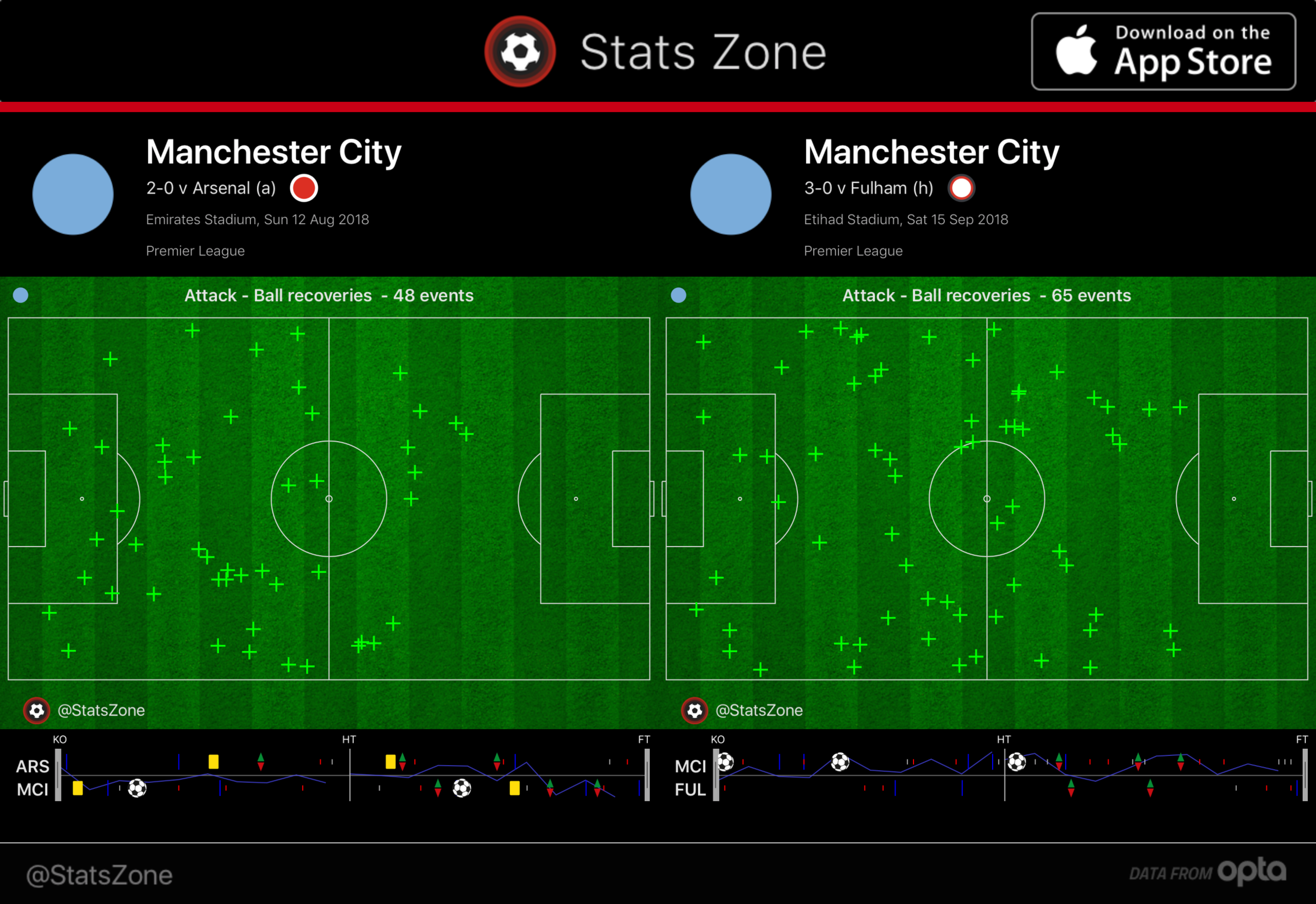
image2

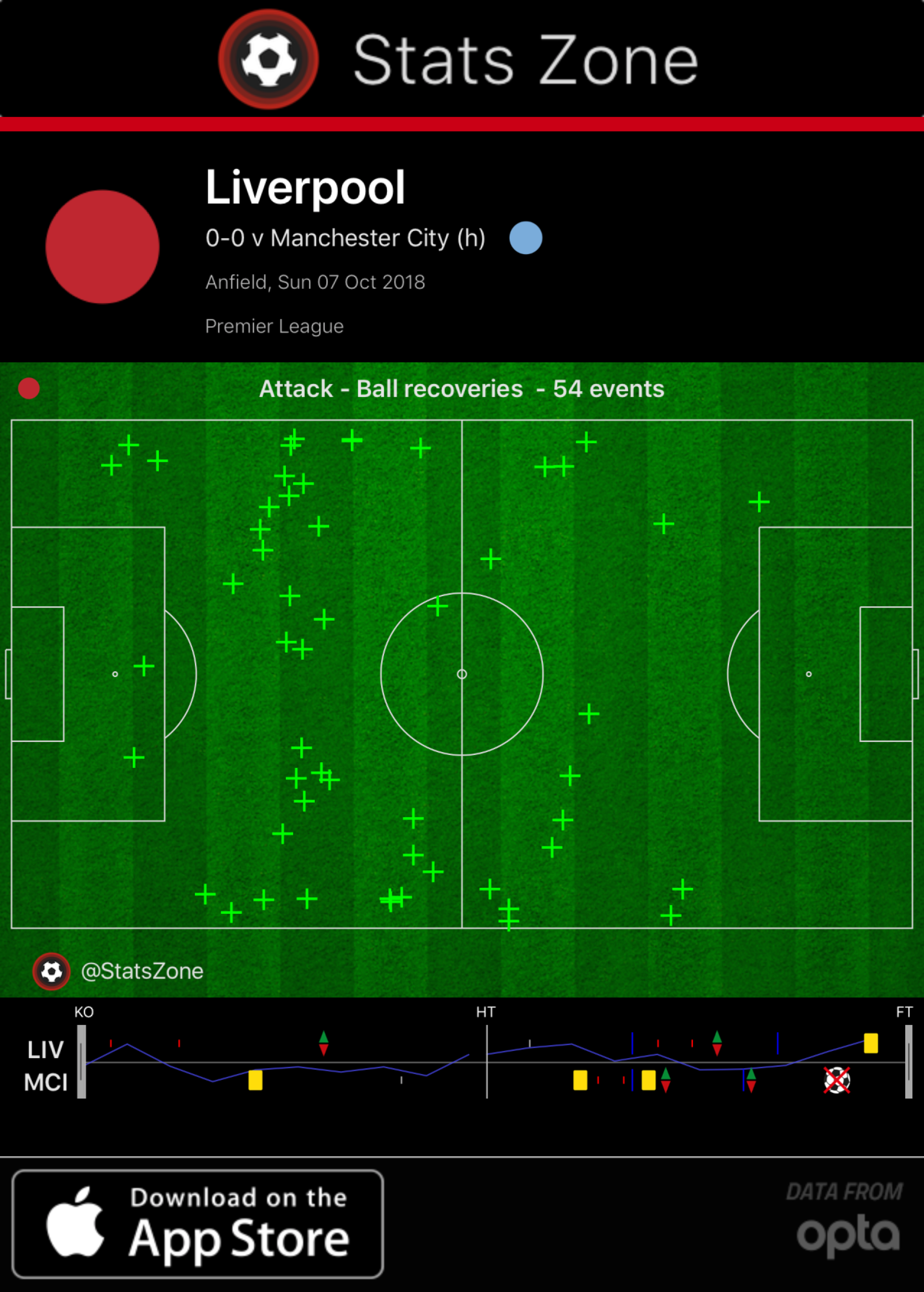
Whilst only on four occasions have their opponents recovered possession in the City half more than 11 times. These games were the three away games against fellow top 6 members (Arsenal, Liverpool and Spurs) and their only defeat, at home to Lyon in the opening Champions League game.
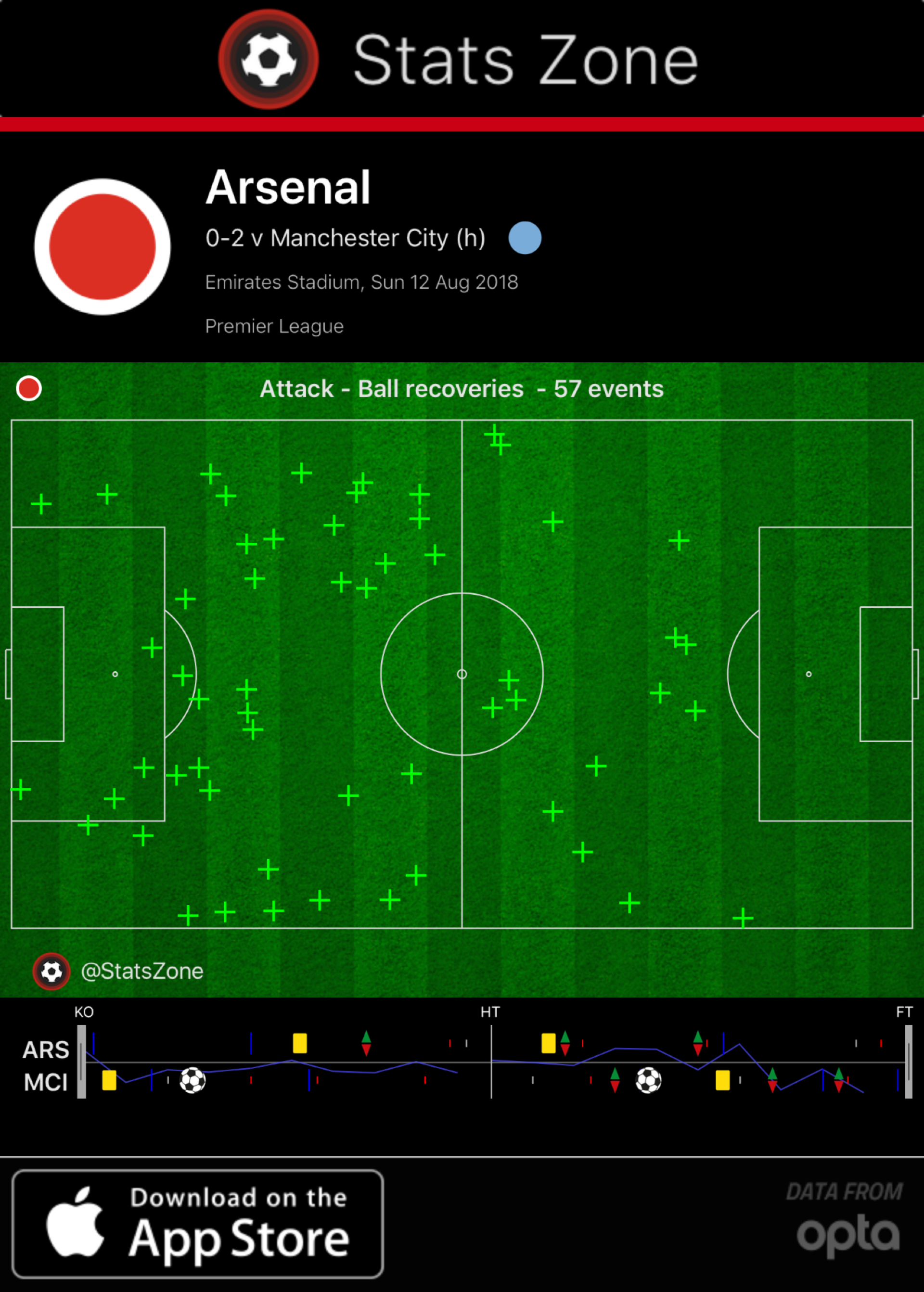
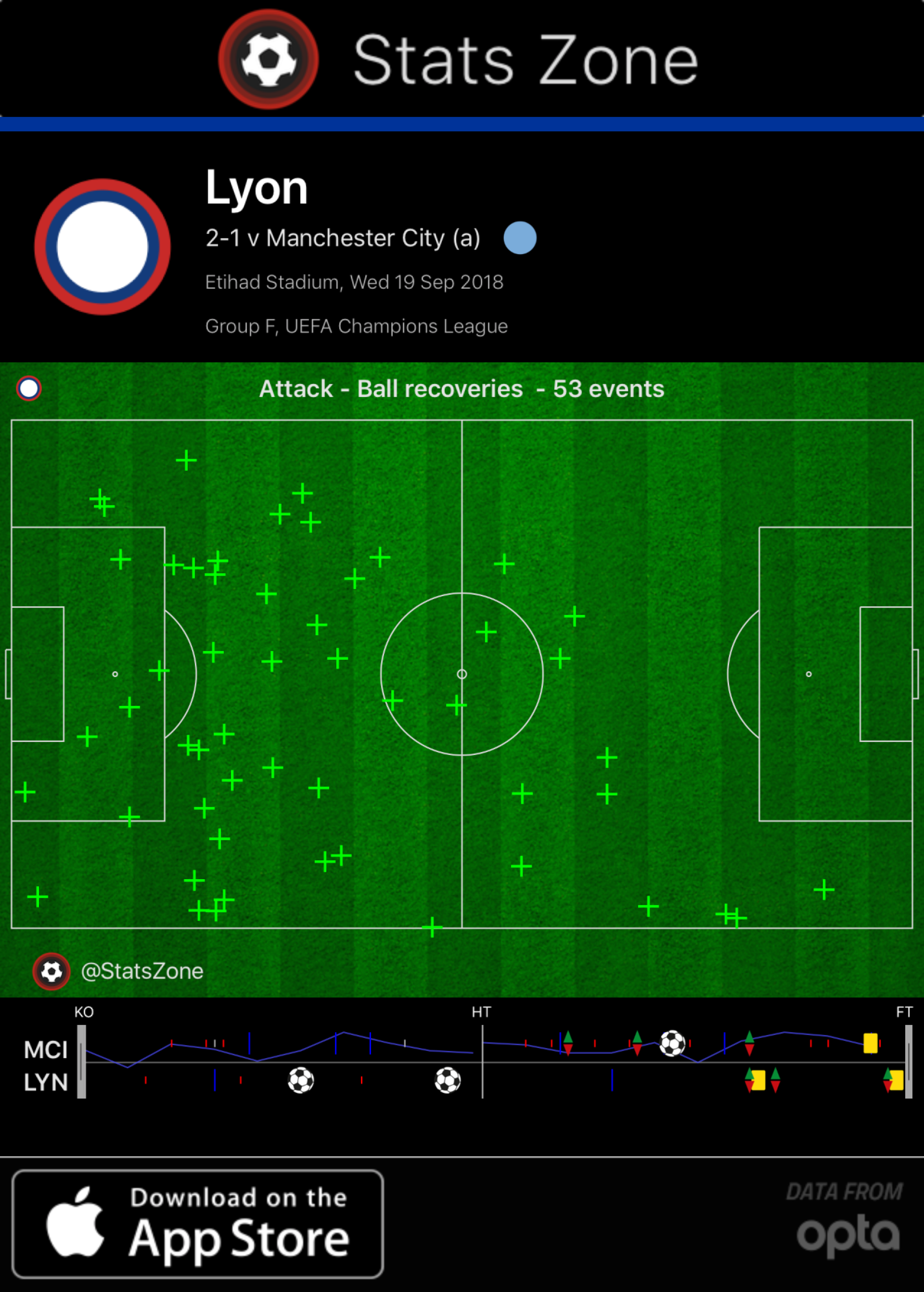
Out of the 14 games City have played, these four were among those where they looked the least clinical version of themselves. They beat Arsenal 2-0 however arguably should have won by more. The 0-0 draw against Liverpool looked like a game with two teams who didn’t want to lose cancelling each other out, hardly any chances were created in that game. They won 1-0 against Spurs in another game where arguably City should’ve score more. In their 1-2 loss to Lyon with Guardiola in the stands, they met a clinical Lyon side and couldn’t create a big chance all game. In each of these games City didn’t look at their best, and in each of them, their opponents recovered the ball in City’s half as much as City recovered the ball in their half (63 v 54). In the other 10 games, City recovered the ball in the opposition half 168 times and conceded recoveries only 58. That’s only four more than the four least clinical games City had.

Not only does recovering the ball high up the pitch prevent the opposition from getting anywhere near your goal and therefore no chance to score, it also instantly puts you on the front foot and creates better scoring opportunities for your own team. We know that City are such a good team with the ball, however this suggests that many of their great chances probably also come from winning the ball back from teams high up the pitch. It may seem obvious and easier said than done, but if you are able to prevent City from doing this to you or if you are able to recover the ball high up the pitch against them then that looks the best way to disrupt them. Limiting the number of times they recover the ball in your half gives you the chance to move the ball further towards their goal and prevents them from exploiting your defensive transitions.

The players with the most recoveries per start for Manchester City seem to be the players who have played the most this season. This suggests that it’s something Guardiola keeps an eye on and favours in his players. I have counted the number of times a player has made 5+ recoveries in a game compared to how many starts that player has had. The top 3 are Mendy (8 times/9 starts), Fernandinho (12/14) and Laporte (10/14). The games which Mendy missed, Delph (3/4) and Zinchenko (1/1) covered for him and appears to be a recovery gold mine at City’s left side.

Credit to @StatsZone for the graphics and recovery numbers.

@TLMAnalytics

#2 Team Analysis: The Rise (and Rise?) of Deportivo Alaves

I will take a look at the intriguing situation that Deportivo Alaves have found themselves in. Comparing where they were a year ago to where they are now, I will look to identify whether or not their current results are sustainable.

In 2016/2017, Mauricio Pellegrino managed Alaves to 9th place in their first season back in La Liga for 6 seasons. This was a great achievement and quickly drew the eyes of the Premier League where he went on to manage Southampton. Luis Zubeldia, an Argentine who had never managed in Europe before, took over for the start of the 2017/2018 season before being sacked after losing and failing to score in each of the first four games. Gianni De Biasi, who was previously the Albania coach who managed to qualify them to their first major tournament, replaced Zubeldia. Though he managed to get them their first goals and wins, it wasn’t enough as after only two months in charge his contract was terminated as Alaves sat rock bottom of the La Liga table on 6 points. They had 2 wins and 11 losses from 13 games, only scoring 7 goals and conceding 22. After a great first season back in La Liga finishing 9th the year before, this wasn’t exactly how they’d hoped the start of their second season would go. Since then, Abelardo Fernandez has been in charge and has won 19 out of 35 La Liga games, winning 1.74 points per game. Alaves would’ve finished 5th in the 2017/2018 season had they maintained that across a season and qualified for Europe. After 10 games in the current 2018/2019 season, Alaves find themselves 2nd only behind Spanish giants Barcelona.

Apart from the set back early in 2017/2018, Alaves have proved they are well worth their place in La Liga. In only their 3rd season back to La Liga they are sitting in 2nd place, I will take a look at the stats behind their recent fixtures to judge how sustainable their recent results have been.

So far Alaves have won 6 games, drawn 2 games and lost 2 games, meaning they are at 2 points per game and results are better than average across Fernandez’ tenure. They have scored 14 goals and conceded only 9, however their expected goals (xG) is 10.41 and expected goals against (xGA) is 13.59. Alaves are outperforming their expected returns at both ends of the pitch, they are scoring more than and conceding less than is expected based on the shots that have occurred. When a team is outperforming their expected goals, it is usually not sustainable, elite level finishing is the exception. We can expect that Alaves will regress back to the mean, wherever that mean is.

Even though Alaves have outperformed their xG/xGA as a total, looking at each match they’ve played individually tells a different story. Since they appear to be over performing expectation, you may expect that they over perform in each game. This is not the case as there is only one game that they have won where they had a lower xG than their opponent (1.10 – 0.85 vs Real Valladolid [away]). This includes their win against Real Madrid in which they snatched victory in the last-minute to earn a 1-0 win with xG of 0.95 – 0.84.

Two games in particular highlight the importance of looking at individual games, their first game away to Barcelona and their away trip to Rayo Vallecano. Barcelona thrashed Alaves 3-0 on the opening day after receiving a guard of honour for winning the title last year, with xG of 3.27 – 0.25. So 3.27/13.59 of xGA and 3/9 of their goals against all came in the first game, in the nine games since then they have had an xG of 10.32 and conceded 6. They are still out performing xGA, however it’s a much more representative view. Several games later, Alaves won 1-5 away to Rayo Vallecano with xG of 1.08 – 1.25. Helped out by a Rayo Vallecano red card and some excellent finishing in the first half, they created some higher xG chances in the second half with more space to counter into and ran away with the game. There were 5/14 of Alaves’ goals but only 1.25/10.41 xG in this game, meaning that in the other nine games they had and scored nine goals from 9.16 xG which looks much more reasonable and sustainable.

Rayo Vallecano v Deportivo Alaves

Across each individual game the xG prediction for a winner is correct 70% of the time (2 draws and 1 loss), if Alaves carry on putting up these numbers for xG and xGA then there’s no reason why their success isn’t sustainable. The only question is whether they can keep it up. Of course, xG doesn’t win you games, actual real-life goals do. Let’s delve into what type of goals and when these goals are scored.

Alaves haven’t scored a single goal in the middle 15 minutes of any half (15-30/60-75mins). This means all of their goals have come at the start or the end of a half, these are very good times to score. A goal at the start of a half will put you on the front foot and a goal at the end of the half gives the opposition little time to react, if it’s just before half time you can go and regroup whilst if it’s just before the end of the game there’s usually no time for reply. It is not a conscious decision when they decide to score but provides insight into the flow of how Alaves try to play. Explosive starts to each half with a quieter middle to relax before ending strongly. Alaves are very good at finishing halves but whether that style of play is sustainable is another matter, out of the 10 games they’ve played in they have scored in 90+ minutes five times. This has won them three games and drawn one meaning that they have gained seven points from last-minute goals. That is not sustainable.

Considering that Alaves appear to be over performing their expected returns at both ends at a total level, the fact that they have scored goals in 90+ minutes in half of their La Liga games and they are currently sitting at 2 points per game which is above their average in the last year, it doesn’t appear that their current results are sustainable. That’s not to say that they will revert back to the relegation battling side a year ago, but they will regress back to their mean somewhere in between.

Credit to understat.com once again for their amazing site and xG models. Check them out.

@TLMAnalytics

#1 Match Report: BVB 4 – 0 Atletico Madrid

Hello world,

After reading and consuming lots of amazing pieces of analysis that’s out there in the football analytics community, I found myself inspired. Watching football is now also an evaluation of performance rather than just for pure entertainment, here’s a place for me to keep tabs of some of the thoughts I have. Match reports, individual performances and defensive structure will all be on the agenda. Constructive criticism is welcome, please feel free to get in touch!

What this report aims to do is to look back on the game and highlight the key areas of importance. That will be looking at team structures and how the team has been set up to play, individual performances and suggested changes that may (or may not) have improved performance.

Initial Thoughts:

  • Dortmund have started the season exceptionally, unbeaten after 9 games in the league with 29 goals scored from only 18.42 xG. Mainly due to Paco Alcacer’s 7 goals from 2.4 xG
  • Atletico have been unspectacular, not really been tested since beating Real Madrid in the Super Cup.
  • The extreme result is what drew my attention to this game, it’s not every day that Atletico concede four.

Match Analysis:

We have an unexpected extreme score line, let’s see if there’s anything clear to explain why.

Number of shots, completed passes, attacking third passes, tackles, interceptions, fouls and possessions are all even. The main difference is in big chances and big chances created, where Dortmund have four and three respectively compared to Atletico’s zero. Considering Atletico only conceded two big chances to Real Madrid at the Bernabau at the end of September, four could be seen as significant.

Checking the attacking dashboards on Statszone for both teams explains where Dortmund were successful and Atletico weren’t. All of Dortmund’s goals were scored from shots between the width of the posts, this means the chances they created to shoot were optimal. Shooting from between the width of the goal produces the largest angle available of the goal to aim at. They favoured attacking down their left-hand side. Atletico lacked penetration into the box, with many incomplete passes and crosses into the box. They crossed the ball from deep into the box aiming for their forwards, if defences are expecting a cross they are easier to defend and attempts at goal resulting from crosses are harder to convert than others.

There is a clear distinction in styles of chances created between the two teams. Dortmund’s chances were of higher quality as they had shots from between the posts, whilst Atletico resorted to attempts from crosses.

How does a team that’s so rigid and robust in defence such as Atletico give up higher quality chances? If they did so on a consistent basis they wouldn’t be known for having that rigid and robust defence.

The context of how the goals were scored and when is important. At half time, Dortmund had only created one big chance from a corner and had scored from a long-range, deflected Axel Witsel shot. Not too much to split the sides. Considering both have won their opening two games, these two teams will be fighting for the top spot of Group A to get the best possible draw in the knockout rounds. This means that this is a game that Atletico would like to win, and after the uneventful first half, was probably a game that they felt they could win or at least get a draw out of the game.

In the second half, Atletico attempted 16 crosses compared to just 8 in the first half. Only 7 of the 24 were completed. Dortmund only attempted 6 all game. The increased frequency of crosses also came with an increase in clearances from 10 (8 in the box) to 14 (all 14 in the box) for Dortmund. This suggests that despite the increased frequency, Atletico weren’t creating any more or clearer chances. Atletico don’t play with clear wingers, this is part of what gives them such a rigid base, so their full backs have to provide the width. When losing possession getting back into that defensive shape quickly is important. Due to the nature of their attack, Atletico lost possession many times from attempted crosses which gave Dortmund many chances to counter attack. Producing chances from counter attacking against a team that is trying to recover defensive shape will produce good chances since there are fewer defenders and these defenders aren’t always set up properly. Not even Atletico are exempt from this. Dortmund completed less passes in the attacking third in the second half, but completed more passes into the opposition box. This suggests that Dortmund were able to be more productive with fewer opportunities. The difference is Atletico were set up defensively in the first half and were recovering from incomplete crosses in the second.

The resulting half boiled down to whether Atletico could break Dortmund down or whether Dortmund would extend their lead on the break. One well worked move, one perfectly executed counter attack and two assists later for Achraf Hakimi and Dortmund are 3-0 up. An extremely poor decision and pass from Felipe Luis gave Dortmund their fourth and the unpredictability of football wins again.

Ultimately, Atletico are still the defensive unit that we see them as. They just need to decide that’s the way they want to play the game. They did for 45 mins and were unlucky to be behind, they decided not to for 45 mins and conceded three late goals. Atletico will be okay as long as plan A works. Dortmund a tad fortunate, but we seem to be saying that so much recently that it’s getting uncomfortably like that’s just what they do.

@TLMAnalytics

Credit to understat.com for the xG numbers and Statszone for the graphics. Please go check them out they are amazingly useful resources.

twitter_header_photo_2